February 26, 2026 · 4 min read
Dopamine
As software engineers shift from builder to agent orchestrator, are we ready for the psychological impact of constant AI-driven wins?

By Peter Kirkup
A lot has been written in the last few weeks about the amazing transformation that software development is undergoing - with software engineers finding their role pivoting almost overnight from builder to manager - the skill now required to orchestrate a number of agents and ensure their output stays on track, tested and reviewed before use in production.
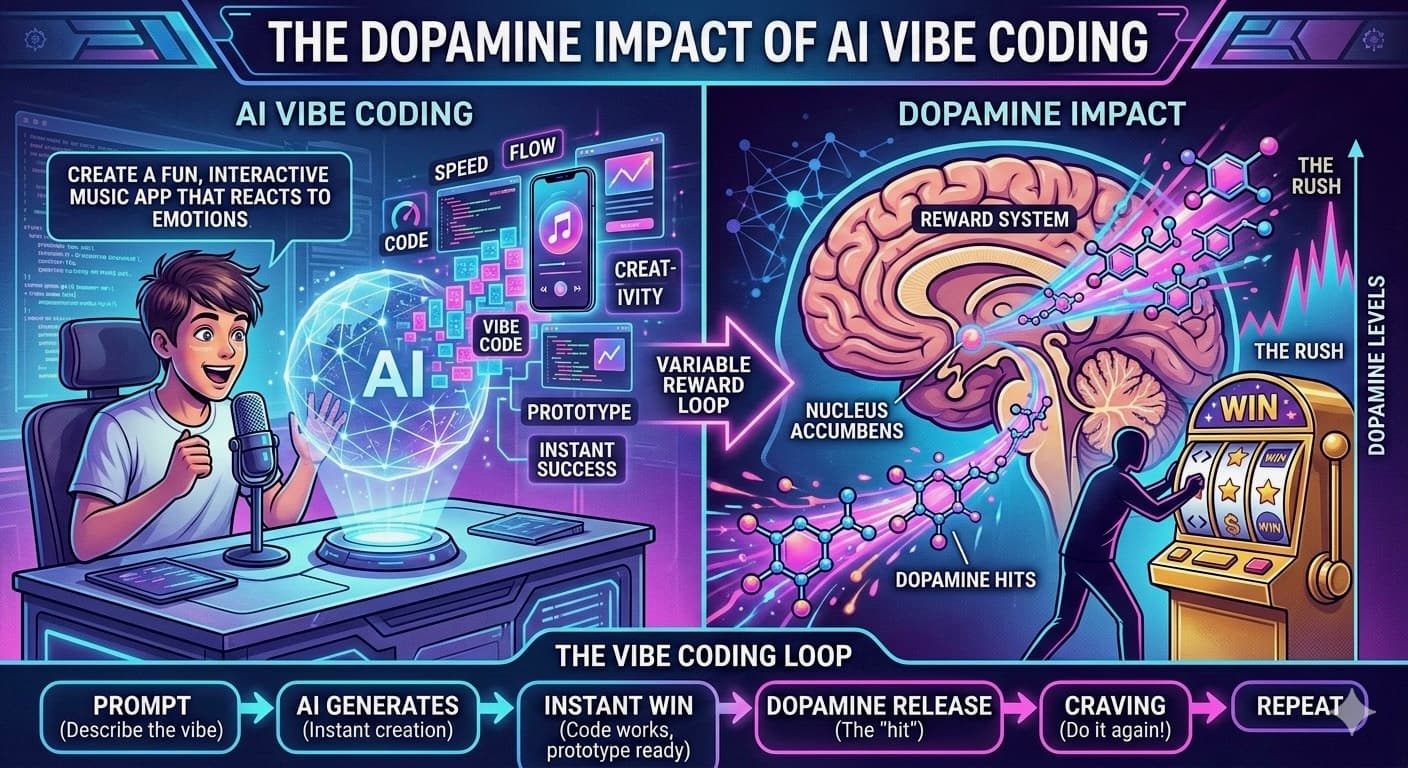
This transformation and reimagining of the role comes with a side effect I have not seen people speaking about - dopamine. The rate of a "win" in traditional software development is relatively modest - a hand-crafted piece of code compiled and tested can yield that hit, but the frequency and height of the dopamine hit is extremely measured.
In the new world, we find ourselves in an almost continuous spike - an autonomous agent builds a feature we had imagined but not had time or headspace to implement - it delivers it fully working in minutes, testable and without the mental lift previously required - instant dopamine hit, and likely followed by an immediate follow-up prompt to expand the feature or adjust the spec as the ability to iterate unlocks.
The breed of software engineers from the past are not conditioned for these dopamine hits, and the cycle ends up with a potentially addictive and certainly life-changing empowerment which is not being spoken about. Professional athletes train to handle the ups and downs, but now a software engineer can find themselves in a spiral of constant improvement without any thought on how their mind and body handle that.
I have read about CEOs who once founded companies which now employ thousands of people leaning back into software development because this shift is so empowering and gratifying.
The latest breed of agents or claws, as they seem to be emerging as - OpenClaw and its descendants - bring this to the headless intrusive environment of mobile devices. Your agent can command your attention over WhatsApp or Telegram, providing you an update and urging you to feed it with more requests. Cursor is delivering feature videos after implementation, bringing the high even further - no need to test the thing yourself, here is working proof - what is next?
But where will it lead us? Is vibe coding the new doom scrolling - eating into our lives, taking place on tube trains, in the living room, prodding us night and day encouraging us to take one more hit.
In any other space, a rapid adoption of dopamine-inducing change would be called an addiction. Is it time we start Agents Anonymous?